Mining with a mission: Jill Ford on Bitcoin, AI, and building for the long term
Mining with a mission Jill Ford’s vision for Bitcoin mining, AI integration, and building sustainable, long-term crypto infrastructure.

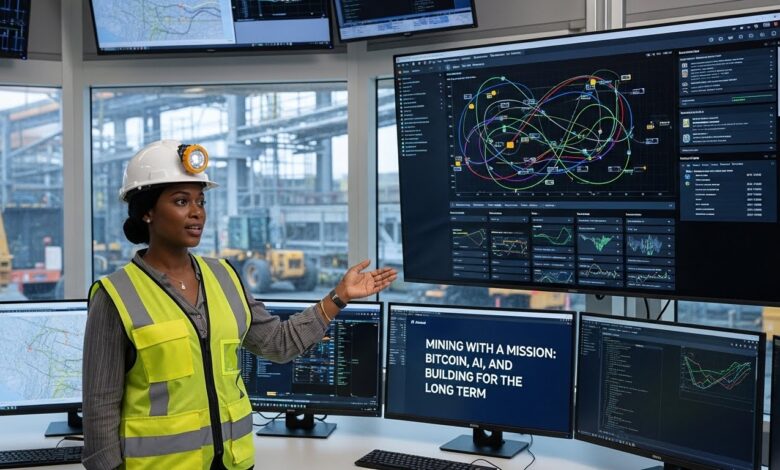
The cryptocurrency industry has matured far beyond its early days of ideological debates and speculative trading frenzies. By 2026, conversations around Bitcoin are no longer limited to price charts or halving cycles. Instead, they increasingly focus on infrastructure, sustainability, and long-term value creation. At the center of this shift is a new generation of leaders who see Bitcoin mining not just as a technical process, but as a mission-driven enterprise. Jill Ford stands out as one of those voices, blending pragmatic engineering, forward-looking AI strategy, and a values-based approach to building resilient systems.
“Mining with a mission” is more than a catchy phrase. It reflects a philosophy that aligns Bitcoin, artificial intelligence, and responsible infrastructure development into a single long-term vision. Jill Ford’s perspective resonates at a time when the industry is under pressure from regulators, environmental critics, and increasingly sophisticated market participants. Her approach reframes mining as critical digital infrastructure, akin to data centers or energy grids, rather than a disposable speculative activity.
This article explores Jill Ford’s ideas on Bitcoin mining, the role of AI in optimizing decentralized networks, and what it truly means to build for the long term in a fast-moving technological landscape. Along the way, we examine how mission-driven mining, AI-powered optimization, and sustainable Bitcoin infrastructure are shaping the future of the crypto economy.
Jill Ford’s background and vision in the Bitcoin ecosystem
Jill Ford’s influence stems not from loud predictions or viral social media posts, but from consistent, systems-level thinking. Her career trajectory bridges traditional infrastructure planning, emerging technologies, and decentralized finance. This blend allows her to speak fluently to engineers, investors, and policymakers alike, positioning her as a credible voice in conversations about Bitcoin’s future.
At the heart of her philosophy is the belief that Bitcoin mining should be treated as critical infrastructure. Just as telecom networks or cloud computing systems are built with decades in mind, Ford argues that mining operations must be designed for durability, adaptability, and social legitimacy. This view contrasts sharply with short-term mining models that chase cheap energy without considering regulatory, environmental, or community impacts.
Her vision emphasizes alignment. Bitcoin, AI, energy systems, and human incentives must reinforce each other rather than compete. In this sense, mining with a mission becomes a framework for long-term resilience rather than short-term profitability.
Bitcoin mining beyond hash rate economics
Bitcoin mining as digital infrastructure
To many outsiders, Bitcoin mining still appears as a race for computational power, measured purely in hash rate and operational cost. Jill Ford challenges this reductionist view by framing mining as the backbone of Bitcoin’s security and monetary credibility. Without miners committing capital, energy, and expertise over long horizons, the network’s decentralized promise would weaken.
From this perspective, Bitcoin mining infrastructure is not disposable hardware but a long-lived system that secures trillions of dollars in value. Decisions about location, energy sourcing, and governance ripple through the broader ecosystem. Ford stresses that miners who ignore this responsibility risk undermining both their own business models and Bitcoin’s legitimacy.
The role of incentives in long-term mining success
Ford often highlights that Bitcoin’s brilliance lies in its incentive structure. Miners are rewarded not merely for computation, but for honesty, uptime, and network participation. However, when miners optimize only for short-term gains, those incentives can become distorted. Excessive leverage, opaque operations, or environmentally reckless practices invite backlash and regulation.
By contrast, long-term Bitcoin mining strategies align profitability with network health. These strategies prioritize transparency, community engagement, and operational efficiency over speculative expansion. According to Ford, miners who internalize this mindset are better positioned to survive market downturns and regulatory shifts.
The intersection of Bitcoin and AI: A new operational paradigm

AI as a tool for mining optimization
Artificial intelligence has quietly become one of the most transformative forces in Bitcoin mining. Jill Ford sees AI not as a threat to decentralization, but as a powerful tool to enhance it. From predictive maintenance to energy load balancing, AI-driven mining optimization improves efficiency without compromising Bitcoin’s core principles.
Machine learning models can forecast hardware failures, optimize cooling systems, and dynamically adjust hash rate in response to energy market fluctuations. These capabilities reduce waste and operational risk, allowing miners to operate sustainably even in volatile conditions. Ford emphasizes that AI, when deployed responsibly, strengthens Bitcoin’s resilience rather than centralizing control.
AI and energy efficiency in mining operations
Energy remains the most contentious aspect of Bitcoin mining. Critics often overlook how advanced technologies are reshaping the energy profile of the industry. Ford points to AI-enabled energy management systems that align mining demand with surplus or renewable energy supply.
By integrating AI into energy-efficient Bitcoin mining, operators can act as flexible load participants in power grids. This not only lowers costs but also stabilizes energy systems, particularly in regions with intermittent renewable sources. Ford argues that this synergy transforms mining from an energy problem into an energy solution.
Building for the long term in a volatile crypto industry
Infrastructure over speculation
One of Jill Ford’s recurring themes is the danger of short-term thinking. Crypto markets are notorious for boom-and-bust cycles, and mining businesses are especially vulnerable. Building for the long term means resisting the temptation to over-expand during bull markets and instead focusing on scalable, resilient infrastructure.
Ford advocates for capital discipline, modular expansion, and conservative assumptions. This approach may appear less exciting during euphoric phases, but it pays dividends during downturns. Long-term Bitcoin infrastructure attracts patient capital, fosters trust with regulators, and supports consistent network security.
Governance, transparency, and trust
As Bitcoin mining grows more visible, governance becomes unavoidable. Jill Ford emphasizes that miners must proactively engage with regulators, communities, and investors. Transparency around energy use, emissions, and operational practices builds credibility and reduces the risk of hostile regulation.
Trust, in this context, is a competitive advantage. Mining firms that operate openly and responsibly are more likely to secure favorable energy contracts, regulatory clarity, and institutional partnerships. Ford frames governance not as a constraint, but as an enabler of sustainable growth.
Sustainability and the evolving narrative of Bitcoin mining
Reframing the environmental debate
The environmental critique of Bitcoin mining has dominated headlines for years. Jill Ford acknowledges the validity of these concerns but argues that the narrative often lags behind reality. Modern mining increasingly relies on renewable energy, stranded power, and waste heat recovery.
Ford’s mission-driven approach centers on sustainable Bitcoin mining as both an ethical imperative and a business necessity. Miners who ignore environmental considerations face rising costs, reputational damage, and regulatory risk. Those who embrace sustainability, however, unlock new opportunities and partnerships.
Mining as a catalyst for renewable energy
An often-overlooked aspect of Bitcoin mining is its role in accelerating renewable energy deployment. Because miners can operate in remote locations and adjust demand dynamically, they provide a revenue floor for renewable projects that might otherwise be unviable.
Jill Ford highlights cases where mining has supported hydro, solar, and wind development by monetizing excess generation. This symbiotic relationship challenges the assumption that Bitcoin mining inherently harms the environment, positioning it instead as a tool for energy innovation.
The human element: Leadership and culture in mining companies
Mission-driven leadership in crypto

Technology alone does not determine success in Bitcoin mining. Jill Ford places significant emphasis on leadership and organizational culture. Mission-driven leaders attract talent, foster accountability, and make decisions that prioritize longevity over hype.
In an industry often criticized for opportunism, mission-focused Bitcoin mining leadership stands out. Ford argues that clear values help teams navigate uncertainty and maintain ethical standards even under financial pressure.
Building teams for a long-term vision
Hiring and retaining skilled professionals is increasingly challenging as mining operations grow more complex. AI engineers, energy specialists, and compliance experts are now as essential as hardware technicians. Ford believes that investing in people is as critical as investing in machines.
Strong internal culture supports innovation, safety, and continuous improvement. Over time, this human capital becomes a defensible advantage that competitors cannot easily replicate.
Bitcoin mining, AI, and the future of decentralized systems
Resilience in an age of uncertainty
The convergence of Bitcoin and AI reflects a broader trend toward decentralized, adaptive systems. Jill Ford sees this convergence as a response to global uncertainty, from geopolitical instability to energy transitions. Bitcoin mining, when built responsibly, contributes to financial resilience by securing a neutral, censorship-resistant monetary network.
AI enhances this resilience by enabling smarter, more responsive operations. Together, these technologies create infrastructure capable of adapting to shocks without centralized control. Ford views this as a blueprint for future digital systems beyond finance.
Beyond mining: Implications for the broader crypto economy
While mining remains her primary focus, Ford’s ideas extend to the wider crypto ecosystem. Decentralized finance, data markets, and AI-driven networks all depend on reliable, secure infrastructure. The principles of building for the long term apply across these domains.
By aligning incentives, technology, and values, Jill Ford’s mission-driven framework offers lessons for anyone building in crypto. It suggests that sustainability and profitability are not opposing forces, but mutually reinforcing goals.
Conclusion
“Mining with a mission” captures a pivotal shift in how Bitcoin mining is perceived and practiced. Jill Ford’s perspective challenges outdated narratives and reframes mining as essential, future-oriented infrastructure. By integrating AI, prioritizing sustainability, and committing to long-term thinking, her approach demonstrates that Bitcoin mining can be both profitable and principled.
As the crypto industry matures, voices like Ford’s will shape its direction. The success of Bitcoin will depend not only on code, but on the people and philosophies guiding its infrastructure. Mining with a mission is ultimately about stewardship—of technology, energy, and trust—in service of a decentralized future.
FAQs
Q: What does “mining with a mission” mean in Bitcoin mining?
Mining with a mission refers to a values-driven approach to Bitcoin mining that prioritizes long-term infrastructure, sustainability, and network health over short-term profits.
Q: How does AI improve Bitcoin mining operations?
AI enhances mining by optimizing energy usage, predicting hardware failures, and improving operational efficiency, making mining more sustainable and resilient.
Q: Why is long-term thinking important in Bitcoin mining?
Long-term thinking helps miners survive market cycles, build trust with regulators and communities, and contribute to Bitcoin’s overall security and legitimacy.
Q: Is Bitcoin mining compatible with renewable energy?
Yes, Bitcoin mining can support renewable energy by monetizing surplus power and providing flexible demand, which helps stabilize energy grids.
Q: What makes Jill Ford’s perspective unique in the crypto industry?
Jill Ford combines technical expertise, AI integration, and mission-driven leadership, offering a holistic view of Bitcoin mining as critical, sustainable infrastructure rather than speculative activity.