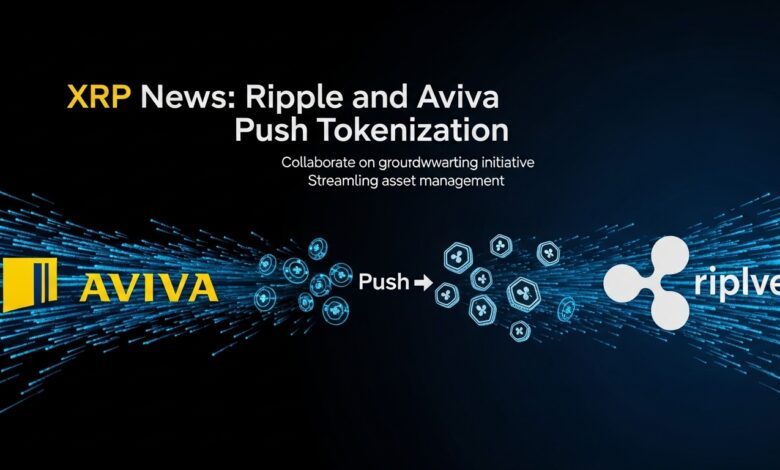
XRP News Ripple and Aviva Push Tokenization on XRP has taken a major turn with the announcement that Ripple has partnered with UK investment giant Aviva to explore and advance tokenization initiatives on the XRP ecosystem. This collaboration reflects a growing trend where traditional financial institutions are increasingly turning toward blockchain technology to modernize their infrastructure and unlock new efficiencies. As tokenization becomes one of the most talked-about innovations in the financial sector, the involvement of a major global investment firm highlights how far the industry has come.
The partnership between Ripple and Aviva represents more than just another corporate announcement. It signals a shift toward institutional adoption of blockchain-based finance, digital asset infrastructure, and real-world asset tokenization. These developments are shaping the future of global finance, and XRP is positioning itself as a key player in this transformation.
In recent years, Ripple has focused heavily on building partnerships with banks, payment providers, and asset managers. The company’s strategy revolves around creating a tokenized financial ecosystem powered by the XRP Ledger, a network designed for speed, low costs, and scalability. With Aviva entering the picture, XRP News is now centered on how tokenization could reshape investment products and open the door to a new era of financial innovation.
XRP News Ripple and Aviva Push Tokenization
Ripple’s long-term vision has always focused on bridging traditional finance with blockchain technology. While the company initially gained attention for its cross-border payment solutions, it has steadily expanded into the world of institutional blockchain solutions and digital asset tokenization.
The partnership with Aviva fits directly into this broader strategy. Ripple has spent years developing the XRP Ledger as a platform capable of supporting not only payments but also tokenized securities, digital bonds, and asset-backed tokens. By working with a global investment firm, Ripple is demonstrating that the XRP ecosystem is ready for large-scale financial applications.
Institutional adoption is a critical milestone for any blockchain project. Retail usage can drive attention and liquidity, but long-term sustainability often depends on the participation of major financial institutions. With Aviva’s involvement, XRP News now reflects a shift toward institutional credibility and real-world use cases.
The Importance of Traditional Finance Partnerships
Partnerships with established financial firms serve as a bridge between legacy systems and emerging blockchain infrastructure. Aviva is one of the UK’s most recognized investment and insurance groups, managing billions in assets. Its decision to explore tokenization with Ripple indicates growing confidence in blockchain-based financial solutions.
Traditional institutions bring regulatory expertise, capital, and market reach. When they collaborate with blockchain companies, the result is often the creation of more compliant and scalable financial products. In this case, the partnership could lead to the development of tokenized investment products, digital asset funds, and new forms of blockchain-enabled financial services.
Understanding Tokenization in the Financial Sector
Tokenization refers to the process of converting real-world assets into digital tokens that can be traded or managed on a blockchain. These assets can include equities, bonds, real estate, commodities, or even fine art. The goal is to create a more efficient, transparent, and accessible financial system.
The XRP Ledger is particularly suited for tokenization because of its fast transaction speeds and minimal fees. This makes it attractive for institutions looking to issue or manage tokenized assets without incurring high operational costs.
How Tokenization Transforms Asset Management
Traditional asset management often involves multiple intermediaries, settlement delays, and complex administrative processes. Tokenization aims to simplify these systems by placing assets directly on a blockchain.
When assets are tokenized, ownership can be transferred almost instantly. Settlement times that once took days can be reduced to seconds. This efficiency not only lowers costs but also reduces counterparty risk and increases transparency.
For firms like Aviva, tokenization could enable new forms of investment products. For example, fractionalized assets could allow investors to own smaller portions of high-value investments. This would open the door to a broader range of participants and increase market liquidity.
The Role of XRP in Tokenized Finance
XRP plays a central role in the Ripple ecosystem. As a digital bridge asset, it can facilitate fast and cost-effective transfers between different currencies and tokenized assets. In a tokenized financial environment, XRP could act as a settlement layer for transactions involving digital securities or tokenized funds.
This functionality positions XRP as more than just a cryptocurrency. It becomes a core component of a blockchain settlement network designed to support institutional finance.
Why Aviva’s Involvement Matters
Aviva’s entry into the tokenization space is significant for several reasons. As a major investment and insurance group, it has extensive experience in managing large portfolios and navigating complex regulatory environments. Its partnership with Ripple adds credibility to the tokenization movement and signals growing institutional interest.
Institutional Confidence in Blockchain Infrastructure
When established financial institutions adopt blockchain technology, it sends a strong signal to the market. It suggests that the technology has matured enough to handle real-world financial operations.
Aviva’s involvement indicates that tokenization is no longer a theoretical concept. It is becoming a practical solution for asset management and investment distribution. This shift is likely to influence other institutions to explore similar partnerships.
Potential Use Cases for Tokenization
The collaboration between Ripple and Aviva could lead to several practical applications. These may include tokenized investment funds, digital insurance products, and blockchain-based portfolio management systems.
Tokenization could also improve liquidity in traditionally illiquid markets. For example, private equity or real estate assets could be tokenized and traded more easily. This would create new opportunities for both institutional and retail investors.
The XRP Ledger as a Tokenization Platform
The XRP Ledger has evolved significantly since its launch. Originally designed for payments, it now supports a wide range of financial applications, including token issuance and decentralized finance features.
Key Advantages of the XRP Ledger
One of the main advantages of the XRP Ledger is its speed. Transactions typically settle in just a few seconds. This is a major improvement over traditional settlement systems, which can take several days.
Another key advantage is cost efficiency. Transaction fees on the XRP Ledger are extremely low, making it suitable for high-volume institutional use. This is particularly important for tokenized assets, where frequent transfers may occur. The ledger also offers built-in features for issuing and managing tokens. These capabilities make it easier for institutions to create and distribute digital assets without relying on complex smart contract systems.
Security and Compliance Considerations
For institutional partners like Aviva, security and compliance are top priorities. The XRP Ledger’s design emphasizes reliability and resilience. Its consensus mechanism does not rely on energy-intensive mining, which makes it more environmentally friendly and predictable.
Compliance features can also be integrated into tokenized assets. For example, issuers can implement restrictions that ensure only approved investors can hold certain tokens. This helps institutions meet regulatory requirements while benefiting from blockchain efficiency.
Broader Implications for the Crypto Market
The partnership between Ripple and Aviva could have ripple effects across the broader cryptocurrency market. Institutional adoption is often seen as a key driver of long-term growth and stability in the digital asset space.
Boosting Market Confidence
When major financial institutions adopt blockchain technology, it increases confidence in the entire ecosystem. Investors often view institutional involvement as a sign of legitimacy and maturity.
This could lead to increased demand for XRP and other digital assets associated with real-world use cases. As tokenization becomes more widespread, cryptocurrencies that support institutional applications may gain a competitive advantage.
Accelerating the Tokenization Trend
Tokenization is already gaining traction in various sectors, including real estate, commodities, and government bonds. The Ripple-Aviva partnership could accelerate this trend by demonstrating a successful collaboration between a blockchain company and a major investment firm.
If the initiative proves successful, it may inspire other financial institutions to explore tokenization on the XRP Ledger or similar platforms. This could lead to a wave of new projects and partnerships across the industry.
Challenges and Considerations
Despite the excitement surrounding tokenization, several challenges remain. Regulatory uncertainty is one of the biggest obstacles. Different countries have different rules regarding digital assets, and these regulations are still evolving.
Regulatory Landscape
For a global firm like Aviva, navigating the regulatory environment is a complex task. Tokenized assets must comply with securities laws, investor protection rules, and anti-money-laundering requirements.
Ripple’s experience working with regulators could help address these challenges. The company has spent years engaging with policymakers and financial institutions, which may give it an advantage in building compliant tokenization solutions.
Technical and Market Risks
Tokenization also involves technical and market risks. Blockchain systems must be secure, scalable, and reliable. Any vulnerabilities could undermine investor confidence.
Market adoption is another factor. Even if the technology is ready, widespread adoption depends on investor demand and regulatory approval. The success of the Ripple-Aviva partnership will likely depend on how these factors evolve.
The Future of XRP and Institutional Finance
The collaboration between Ripple and Aviva represents a significant step toward the mainstream adoption of tokenized finance.
As more institutions explore blockchain solutions, XRP could play a central role in the emerging digital financial infrastructure.
Expanding the XRP Ecosystem
Ripple has been actively expanding the capabilities of the XRP Ledger. New features and partnerships are aimed at attracting developers, institutions, and investors.
With Aviva’s involvement, the ecosystem could see an influx of new tokenized products and financial applications. This would strengthen XRP’s position as a leading platform for institutional crypto adoption and real-world asset tokenization.
Long-Term Outlook
The long-term outlook for XRP will depend on several factors, including regulatory clarity, technological development, and institutional adoption. Partnerships like the one with Aviva suggest that the project is moving in a direction that aligns with the future of finance.
As tokenization continues to gain momentum, XRP News is likely to focus increasingly on institutional collaborations and real-world applications rather than purely speculative trends.
Conclusion
The partnership between Ripple and UK investment giant Aviva marks an important milestone in the evolution of tokenized finance. By working together to explore tokenization on the XRP ecosystem, the two companies are contributing to a broader shift toward blockchain-based financial infrastructure. This development highlights the growing interest of traditional financial institutions in digital assets and tokenization. It also reinforces XRP’s position as a platform designed for real-world financial applications. As the partnership progresses, it could pave the way for new tokenized investment products, improved liquidity, and more efficient financial systems.
While challenges remain, the collaboration between Ripple and Aviva demonstrates that institutional adoption of blockchain technology is accelerating. For the XRP ecosystem, this could signal the beginning of a new phase focused on practical use cases and long-term growth.
FAQs
Q: What does the Ripple and Aviva partnership mean for XRP?
The partnership between Ripple and Aviva signals growing institutional interest in the XRP ecosystem. By working together on tokenization initiatives, the two companies aim to create blockchain-based financial products that could increase the real-world utility of XRP. This collaboration also strengthens market confidence in the XRP Ledger as a platform for institutional finance.
Q: What is tokenization and why is it important?
Tokenization is the process of converting real-world assets into digital tokens on a blockchain. This approach can make asset management more efficient by reducing settlement times, lowering costs, and improving transparency. It also enables fractional ownership, allowing more investors to access high-value assets.
Q: How could Aviva use tokenization in its business?
Aviva could use tokenization to create digital versions of investment funds, insurance products, or other financial assets. These tokenized products could be traded more easily, settled faster, and managed with greater transparency. This could improve efficiency and open new opportunities for both institutional and retail investors.
Q: Why is the XRP Ledger suitable for tokenization?
The XRP Ledger is designed for fast and low-cost transactions, making it well suited for tokenized financial applications. It offers built-in features for issuing and managing tokens, which simplifies the process for institutions. Its efficiency and scalability make it attractive for large-scale financial use cases.
Q: Could this partnership affect the future price or adoption of XRP?
Institutional partnerships often influence market sentiment and adoption trends. If the Ripple and Aviva collaboration leads to successful tokenization projects, it could increase demand for XRP and strengthen its position in the digital asset market. However, price movements will also depend on broader market conditions, regulatory developments, and investor sentiment.