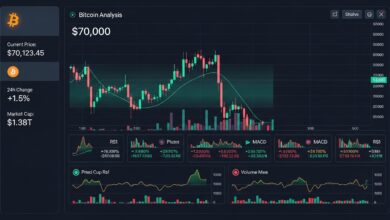
Bitcoin price $90K breakout hangs in balance as US storms Venezuela
Bitcoin price eyes a $90K breakout as US-Venezuela tensions rise, testing crypto market sentiment, risk appetite, and macro resilience.


The Bitcoin price $90K breakout has become one of the most closely watched narratives in global financial markets. After months of consolidation, strong institutional inflows, and renewed optimism following regulatory clarity in key jurisdictions, Bitcoin appeared poised to finally push decisively above the psychologically critical $90,000 level. However, just as momentum began to build, escalating geopolitical tensions—sparked by aggressive US actions toward Venezuela—have injected a new layer of uncertainty into an already fragile macro environment.
Bitcoin has long been marketed as a hedge against political instability, crypto currency debasement, and systemic risk. Yet history shows that during periods of sudden geopolitical shocks, even digital assets can experience heightened volatility as investors rush to de-risk portfolios. The unfolding situation involving the United States and Venezuela is testing whether Bitcoin can truly behave as a safe-haven asset or whether it remains tethered to broader risk markets.
This article explores how rising geopolitical tensions are influencing Bitcoin’s near-term price action, why the $90K resistance zone matters so much to traders and institutions, and what technical, macroeconomic, and on-chain signals suggest about the next major move. By examining the intersection of geopolitics, market psychology, and crypto fundamentals, we aim to provide a comprehensive view of why the Bitcoin price breakout hangs in the balance—and what could ultimately tip the scales.
Why the $90K Level Matters for Bitcoin Price
Psychological and Technical Importance
The $90,000 level is far more than a round number on a price chart. In Bitcoin market structure, such levels often act as psychological barriers where profit-taking accelerates and hesitation sets in. Traders who accumulated Bitcoin at lower prices tend to view these milestones as logical exit points, while new buyers wait for confirmation before committing capital.
From a technical perspective, the Bitcoin price $90K breakout represents the upper boundary of a multi-week consolidation range. Price action below this level suggests indecision, while a clean break and sustained hold above it could open the door to rapid price discovery. Historically, Bitcoin has shown a tendency to move aggressively once major resistance levels are cleared, driven by momentum traders and algorithmic strategies.
The repeated rejections near $90K have reinforced its significance. Each failed attempt increases market tension, making the eventual breakout—or breakdown—more impactful. This is why current geopolitical developments are so critical; they may determine whether Bitcoin finally escapes this range or retreats into deeper consolidation.
Institutional Positioning Around Key Resistance
Institutional investors play a central role in shaping Bitcoin’s price near major resistance zones. Large funds, ETFs, and corporate treasuries often deploy capital strategically, scaling in or out near levels like $90K. On-chain data suggests that long-term holders remain largely inactive, while short-term traders dominate volume near resistance.
The hesitation among institutions reflects broader macro uncertainty. While many funds view Bitcoin as a long-term hedge, they are still sensitive to short-term volatility triggered by geopolitical shocks. As a result, the Bitcoin price breakout depends not only on retail enthusiasm but also on whether institutions are willing to absorb selling pressure during periods of global tension.
US–Venezuela Tensions and Global Market Sentiment
Geopolitical Risk and Risk-Off Behavior
The latest escalation involving the United States and Venezuela has reignited fears of regional instability, energy supply disruptions, and broader geopolitical spillovers. Financial markets tend to respond to such events with a “risk-off” posture, characterized by selling in equities and speculative assets, alongside flows into traditional safe havens like the US dollar and government bonds.
Bitcoin’s behavior during geopolitical crises has been mixed. In some cases, it has rallied on narratives of sovereignty and censorship resistance. In others, it has sold off alongside equities as investors sought immediate liquidity. The current situation is particularly complex because it coincides with a delicate technical phase for Bitcoin.
If geopolitical tensions continue to escalate, short-term traders may reduce exposure, increasing selling pressure below $90K. Conversely, if the crisis underscores the fragility of traditional financial systems, Bitcoin could benefit from renewed interest as a digital store of value.
Energy Markets, Inflation, and Crypto

Venezuela’s role in global energy markets adds another dimension to the analysis. Any disruption to oil supply can reignite inflation concerns, influencing central bank policy expectations. Higher inflation expectations often strengthen the long-term case for Bitcoin as an inflation hedge, but in the short term, they can lead to tighter financial conditions.
For Bitcoin, this creates a paradox. Inflationary pressures support its narrative, but higher interest rates and reduced liquidity can suppress speculative demand. As a result, the Bitcoin price $90K breakout is caught between competing macro forces, making near-term direction highly sensitive to headlines.
Bitcoin as a Safe Haven: Myth or Maturing Reality?
Comparing Bitcoin to Gold During Crises
Gold has long been the benchmark safe-haven asset during geopolitical turmoil. Bitcoin is increasingly compared to gold due to its fixed supply and decentralized nature. However, Bitcoin’s relatively short history and higher volatility complicate this comparison.
During some crises, Bitcoin has outperformed gold, attracting capital from investors seeking alternatives to traditional assets. In other instances, it has behaved more like a high-beta risk asset. The current standoff involving the US and Venezuela could become another defining moment for Bitcoin’s evolving identity.
If Bitcoin can hold above key support levels while global markets wobble, it would strengthen the argument that it is maturing into a true hedge. A successful Bitcoin price breakout above $90K during geopolitical stress would be particularly significant, signaling resilience and growing confidence among investors.
Market Maturity and Liquidity Depth
Bitcoin’s market structure today is far more robust than in previous cycles. Deeper liquidity, regulated derivatives markets, and institutional participation have reduced the likelihood of extreme flash crashes. This maturity could help Bitcoin weather geopolitical storms better than in the past.
However, maturity also means greater integration with global financial markets. As correlations with equities and macro indicators increase, Bitcoin becomes more susceptible to global risk sentiment. Whether this integration ultimately helps or hinders the $90K breakout remains an open question.
Technical Analysis: Where Bitcoin Stands Now
Key Support and Resistance Levels
From a technical standpoint, Bitcoin is trading within a narrowing range just below $90K. Strong support has formed in the mid-$80,000 region, where buyers have consistently stepped in. This support zone is critical; a breakdown below it could trigger a deeper pullback and invalidate the breakout narrative. Resistance remains firmly entrenched around $90K, with sell orders clustered just above this level. A decisive move higher would require strong volume and follow-through, ideally accompanied by positive macro or geopolitical developments.
Momentum indicators show a market in equilibrium. Neither bulls nor bears have full control, reinforcing the idea that an external catalyst—such as a de-escalation or escalation in geopolitical tensions—could determine the next move.
Volume, Volatility, and Market Structure
Volume patterns suggest declining participation as traders await clarity. This compression often precedes significant volatility. When Bitcoin finally breaks out of this range, the move is likely to be sharp and directional.
Volatility metrics also point to an impending expansion. Historically, periods of low volatility near major resistance levels have been followed by explosive price action. For the Bitcoin price $90K breakout, the question is not whether volatility will increase, but in which direction.
On-Chain Signals and Investor Behavior

Long-Term Holders vs Short-Term Traders
On-chain data provides valuable insight into investor behavior. Long-term holders, often considered the backbone of Bitcoin’s market, have shown little inclination to sell near current levels. Their conviction suggests confidence in higher prices over time.
In contrast, short-term traders are more active, contributing to increased churn near resistance. This dynamic creates a tug-of-war that keeps price capped. A breakout above $90K would likely require short-term traders to flip bullish, adding momentum rather than resistance. The persistence of long-term holders supports the broader bullish thesis, even if short-term volatility persists due to geopolitical uncertainty.
Exchange Flows and Supply Dynamics
Exchange inflow data shows no significant surge in coins moving to exchanges, which typically precedes major sell-offs. This indicates that panic selling is limited, despite geopolitical headlines.
At the same time, Bitcoin’s fixed supply and ongoing reduction in new issuance continue to underpin its long-term value proposition. These structural factors remain intact regardless of short-term geopolitical noise, reinforcing confidence in the Bitcoin price breakout over a longer horizon.
Macro Factors Beyond Geopolitics
US Monetary Policy and Dollar Strength
The strength of the US dollar plays a crucial role in Bitcoin’s price dynamics. Geopolitical tensions often boost the dollar as a safe-haven currency, which can pressure Bitcoin in the short term. However, if rising tensions lead to economic slowdown concerns, expectations of looser monetary policy could offset dollar strength. Bitcoin tends to benefit from accommodative monetary conditions. Any संकेत that central banks may pivot toward easing could provide the catalyst needed for a sustained move above $90K.
Global Liquidity and Risk Appetite
Global liquidity conditions remain a key driver of crypto markets. When liquidity is abundant, speculative assets like Bitcoin thrive. When liquidity tightens, risk appetite diminishes.
The current environment is finely balanced. While structural adoption of Bitcoin continues to grow, short-term liquidity is constrained by macro uncertainty. This tension mirrors the Bitcoin price $90K breakout narrative itself—poised but uncertain.
What Could Trigger a Breakout or Breakdown?
Catalysts for a Bullish Resolution
A de-escalation of US–Venezuela tensions could quickly restore risk appetite, encouraging capital to flow back into Bitcoin. Positive regulatory developments, strong ETF inflows, or bullish macro data could also serve as catalysts. In such a scenario, a decisive break above $90K could trigger a cascade of buying, driven by momentum traders and sidelined investors. This would likely mark the beginning of a new leg higher in the current cycle.
Risks That Could Derail the Rally
On the downside, further escalation or unexpected global shocks could push investors into defensive positions. A breakdown below key support would undermine confidence and potentially lead to a deeper correction. However, even a pullback may be viewed as a healthy reset rather than a trend reversal, given Bitcoin’s strong fundamentals and long-term adoption trajectory.
Conclusion
The Bitcoin price $90K breakout stands at a critical crossroads. On one side lies the promise of renewed momentum, institutional confidence, and price discovery. On the other lies the reality of geopolitical uncertainty, macro headwinds, and cautious investor sentiment. The escalating situation involving the US and Venezuela has added complexity to an already delicate technical setup, making the coming weeks pivotal for Bitcoin’s trajectory.
While short-term volatility is likely, the broader picture remains constructive. Bitcoin’s fundamentals, from fixed supply to growing institutional adoption, remain intact. Whether the breakout happens now or after further consolidation, the $90K level will continue to serve as a defining battleground in this cycle. For investors and traders alike, patience and perspective are essential. Geopolitical storms may shape short-term price action, but Bitcoin’s long-term narrative continues to evolve, tested and refined by each new challenge.
FAQs
Q: Why is the Bitcoin price $90K breakout so important?
The $90K level is a major psychological and technical resistance zone. A sustained breakout above it could signal strong bullish momentum and open the door to higher price discovery.
Q: How do US–Venezuela tensions affect Bitcoin?
Geopolitical tensions often trigger risk-off behavior, increasing short-term volatility. They can pressure Bitcoin initially but may also strengthen its long-term appeal as an alternative asset.
Q: Is Bitcoin acting as a safe haven during geopolitical crises?
Bitcoin’s behavior is mixed. It sometimes acts as a hedge, but it can also move with risk assets. Its response depends on liquidity conditions and investor sentiment.
Q: What technical levels should traders watch now?
Key support lies in the mid-$80,000 range, while resistance remains near $90K. A break of either level could lead to a significant move.
Q: Does geopolitical uncertainty change Bitcoin’s long-term outlook?
While it may influence short-term price action, geopolitical uncertainty does not fundamentally alter Bitcoin’s long-term value proposition driven by scarcity and adoption.