Bitcoin Price Forecast: BTC trades within recent range as ETF flows stay weak
Bitcoin price forecast shows BTC trading within a tight range as ETF flows stay weak, shaping short-term volatility and long-term outlook.

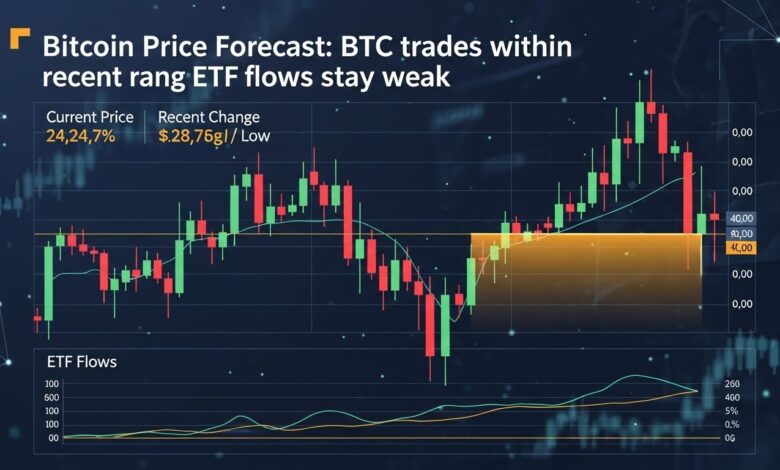
The Bitcoin price forecast has entered a phase of cautious consolidation as BTC continues to trade within a familiar range, reflecting a market that is neither panicked nor euphoric. After months of heightened volatility driven by macroeconomic uncertainty, spot Bitcoin ETF launches, and shifting regulatory narratives, Bitcoin appears to be pausing for direction. Recent price action shows BTC oscillating within its established band, while ETF flows remain weak, offering limited momentum for a decisive breakout.
This period of range-bound trading is significant because it highlights a broader shift in market psychology. Investors are increasingly selective, waiting for clearer signals from monetary policy, institutional demand, and on-chain fundamentals. The excitement surrounding spot Bitcoin ETFs has cooled, and inflows that once propelled BTC higher have slowed, raising questions about whether the next major move will be bullish continuation or deeper consolidation.
In this article, we provide an in-depth Bitcoin price forecast, exploring why BTC is trading within its recent range, how weak ETF flows are shaping sentiment, and what technical, fundamental, and macroeconomic indicators suggest for the weeks and months ahead. By examining BTC price action, institutional behavior, on-chain data, and global market dynamics, this analysis aims to give readers a comprehensive and balanced outlook on where Bitcoin could be heading next.
Bitcoin price forecast overview: a market in consolidation
The current Bitcoin price forecast reflects a market that has entered a consolidation phase following an extended period of directional moves. BTC has repeatedly tested both upper and lower boundaries of its recent trading range, yet neither bulls nor bears have managed to establish sustained control. This behavior often signals equilibrium, where buying interest and selling pressure are relatively balanced.
From a structural perspective, consolidation is not inherently bearish. Historically, Bitcoin has spent considerable time moving sideways after strong rallies or sharp corrections. These periods allow leverage to reset, speculative excess to cool, and long-term holders to accumulate. However, the lack of strong ETF inflows has reduced the catalyst potential that many traders expected to drive the next leg higher.
At the same time, volatility compression suggests that a larger move may eventually emerge. As BTC trades within a narrowing range, market participants are closely monitoring volume trends, derivatives positioning, and macro triggers that could break the stalemate. The Bitcoin price forecast therefore hinges not only on price levels but also on shifts in sentiment and liquidity.
Why BTC trades within a recent range
Market indecision and balanced liquidity
One of the primary reasons BTC trades within its recent range is widespread market indecision. Buyers step in near support levels, viewing pullbacks as opportunities, while sellers emerge near resistance, locking in profits or hedging exposure. This creates a self-reinforcing cycle of range trading.
Liquidity conditions also play a crucial role. While Bitcoin remains highly liquid compared to most digital assets, overall crypto market volume has declined from peak levels. Lower liquidity reduces the probability of sharp breakouts unless driven by a strong catalyst. As a result, the BTC price continues to fluctuate within familiar boundaries.
Impact of macroeconomic uncertainty
Macroeconomic uncertainty has further contributed to Bitcoin’s sideways movement. Global markets are navigating questions around interest rate cuts, inflation trajectories, and economic growth. Bitcoin, often viewed as both a risk asset and a hedge, tends to struggle for direction when macro signals are mixed.
This uncertainty discourages aggressive positioning. Institutional investors, in particular, are more likely to wait for clearer policy guidance before committing large capital allocations. Consequently, the Bitcoin price forecast remains constrained by macro-driven caution.
ETF flows stay weak: implications for Bitcoin
Slowing momentum from spot Bitcoin ETFs
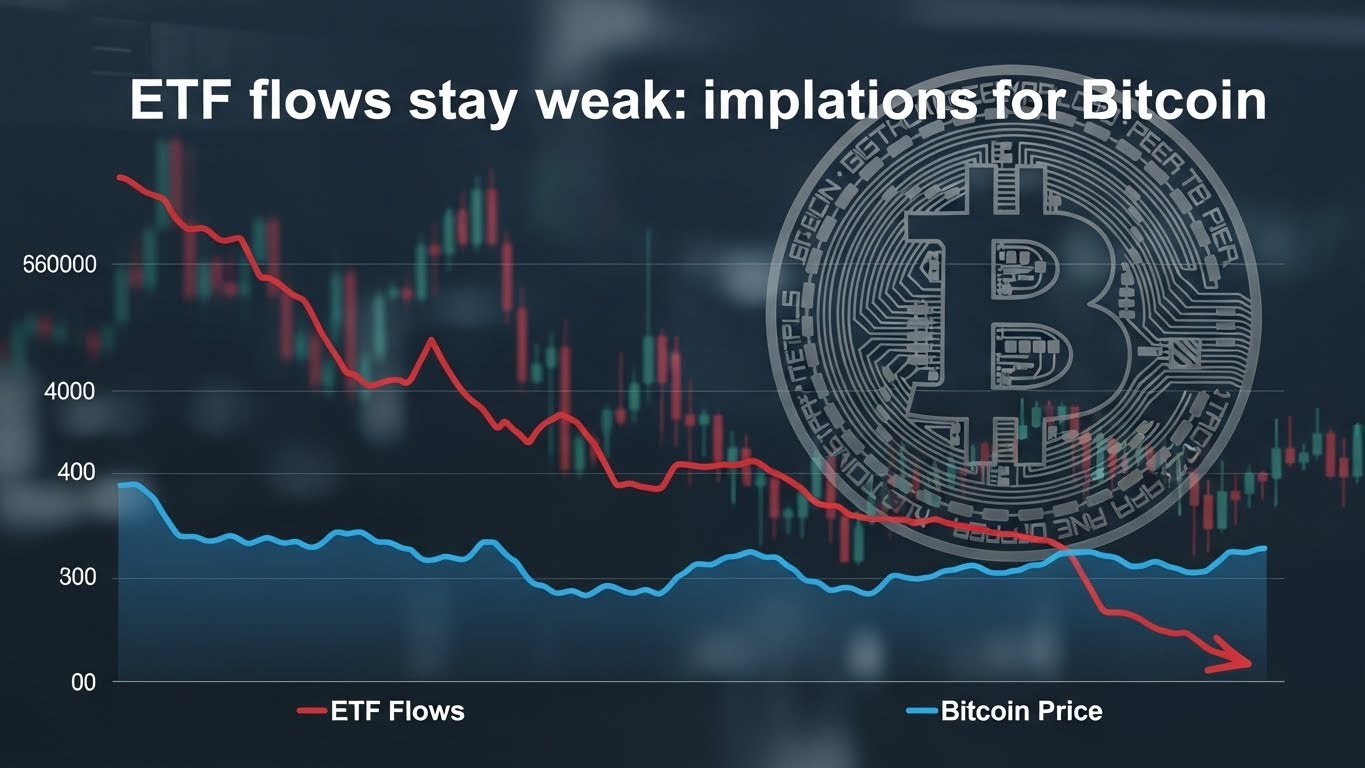
The launch of spot Bitcoin ETFs was widely seen as a watershed moment for crypto adoption. Initial inflows provided strong upward momentum, reinforcing bullish Bitcoin price forecasts. However, recent data shows that ETF flows have weakened, with inflows slowing and occasional outflows emerging.
Weak ETF flows suggest that institutional demand is not accelerating at the pace many anticipated. While ETFs still represent a structural positive for Bitcoin’s long-term legitimacy, their short-term impact on price has diminished. Without consistent inflows, BTC lacks a key source of sustained buying pressure.
Investor psychology and expectations
ETF-related optimism has transitioned into a more measured outlook. Investors now recognize that ETFs are not a guaranteed engine for perpetual gains. This shift in expectations has reduced speculative fervor, encouraging a more disciplined approach to BTC exposure.
From a Bitcoin price forecast perspective, weak ETF flows imply that future price appreciation may depend more heavily on organic demand, network fundamentals, and macro catalysts rather than headline-driven enthusiasm.
Technical analysis: key levels shaping the Bitcoin price forecast
Support zones and downside risk
Technical analysis reveals several critical support zones that underpin the current Bitcoin price forecast. These levels have repeatedly attracted buying interest, reinforcing their importance. A decisive break below major support could trigger increased selling pressure, particularly from short-term traders and leveraged positions.
However, as long as these support areas hold, the downside appears limited. Long-term holders continue to show resilience, reducing the likelihood of panic-driven declines. This dynamic supports the view that BTC’s range-bound behavior may persist until a stronger catalyst emerges.
Resistance levels and upside barriers
On the upside, Bitcoin faces well-defined resistance zones where selling pressure has consistently intensified. These levels often coincide with psychological round numbers and previous highs, making them focal points for traders.
Breaking through resistance would require a surge in volume and renewed confidence, potentially driven by improving ETF flows or favorable macro developments. Until then, the Bitcoin price forecast suggests that BTC may struggle to sustain rallies beyond its current range.
On-chain data and long-term holder behavior
Accumulation versus distribution signals
On-chain metrics provide valuable insight into the underlying health of the Bitcoin network. Recent data indicates that long-term holders are largely maintaining or gradually increasing their positions. This accumulation behavior supports a constructive Bitcoin price forecast over the medium to long term.
In contrast, short-term holders and speculative traders are more active within the range, contributing to choppy price action. This divergence highlights a market split between conviction-based investors and opportunistic participants.
Network activity and fundamentals
Bitcoin’s network fundamentals remain robust, with steady hash rate growth and consistent transaction activity. These indicators suggest that, despite weak ETF flows, the foundational strength of the network is intact.
From a forecasting standpoint, strong fundamentals provide a floor under the BTC price, even if short-term momentum remains subdued. Over time, these factors can reassert influence, especially when external conditions improve.
Institutional sentiment and derivatives markets
Futures and options positioning
Derivatives markets offer clues about trader expectations. Current futures and options data show relatively neutral positioning, with no extreme leverage skewed in either direction. This neutrality aligns with the Bitcoin price forecast of consolidation rather than imminent breakout. Low funding rates and balanced open interest suggest that traders are cautious, preferring to wait for confirmation before committing to directional bets. This environment reinforces range-bound price behavior.
Institutional risk management strategies
Institutions are increasingly using Bitcoin as part of diversified portfolios rather than speculative trades. This shift emphasizes risk management and gradual exposure, which can dampen volatility but support long-term adoption. As institutions prioritize stability, the BTC price may continue to reflect measured participation rather than explosive moves, at least until macro or structural changes alter risk appetite.
Macro factors influencing the Bitcoin price forecast

Interest rates and monetary policy
Interest rate expectations remain a key driver of Bitcoin sentiment. Potential rate cuts could improve liquidity conditions and revive risk appetite, benefiting BTC. Conversely, prolonged restrictive policy may limit upside potential.
The current Bitcoin price forecast must therefore account for evolving central bank narratives. Markets are highly sensitive to policy signals, and Bitcoin’s correlation with broader risk assets remains relevant.
Global risk sentiment and capital flows
Geopolitical developments and global risk sentiment also shape capital flows into Bitcoin. In times of heightened uncertainty, BTC can attract interest as an alternative asset, but this effect is inconsistent. At present, mixed risk sentiment contributes to cautious positioning. This reinforces the idea that Bitcoin will continue trading within its range until a clearer global trend emerges.
Scenarios for Bitcoin’s next major move
Bullish breakout scenario
A bullish scenario for the Bitcoin price forecast would likely involve renewed ETF inflows, improving macro conditions, and a decisive break above resistance. In such a case, momentum traders could re-enter, driving accelerated gains. This outcome would require a shift in sentiment, supported by higher volume and confirmation across technical indicators. While possible, it depends on catalysts that are not yet fully in place.
Continued consolidation scenario
The most probable near-term scenario is continued consolidation. BTC may remain within its established range as markets digest existing information and wait for new developments. This scenario favors range traders and long-term accumulators, reinforcing the idea that patience is required in the current environment.
Bearish breakdown risk
A bearish scenario would involve a breakdown below key support, potentially triggered by adverse macro news or sustained ETF outflows. While this risk exists, strong long-term holder support reduces the likelihood of a severe downturn. Even in a bearish case, the broader Bitcoin price forecast would likely remain constructive over longer horizons, given enduring network strength.
Conclusion
The current Bitcoin price forecast reflects a market in balance, with BTC trading within a recent range as ETF flows stay weak. This consolidation phase underscores a shift from hype-driven momentum to a more measured and fundamentals-focused environment. While weak ETF inflows have reduced short-term upside catalysts, strong on-chain fundamentals and long-term holder conviction provide stability.
As Bitcoin navigates macro uncertainty, institutional caution, and evolving investor expectations, patience becomes a key strategy. Whether the next major move is a breakout, breakdown, or extended consolidation will depend on a combination of liquidity conditions, policy signals, and renewed demand. For now, the range-bound behavior serves as a reminder that Bitcoin’s cycles often include periods of calm before significant change.
FAQs
Q: Why is Bitcoin trading within a narrow range right now?
Bitcoin is trading within a narrow range due to balanced buying and selling pressure, reduced liquidity, and cautious investor sentiment driven by macroeconomic uncertainty and weak ETF flows.
Q: How do weak ETF flows affect the Bitcoin price forecast?
Weak ETF flows limit sustained institutional buying pressure, reducing momentum and contributing to consolidation rather than strong directional moves.
Q: Is consolidation bullish or bearish for Bitcoin?
Consolidation is neutral to slightly bullish, as it allows the market to reset and build a base for potential future moves without excessive leverage.
Q: What technical levels are most important for BTC?
Key support and resistance levels define the current range. A break below support could signal downside risk, while a move above resistance may indicate renewed bullish momentum.
Q: What could trigger Bitcoin’s next major price move?
Potential triggers include changes in monetary policy, renewed ETF inflows, shifts in global risk sentiment, or strong on-chain and institutional demand signals.